
Reduce Sugar Without Replacing It: The Enzyme Advantage

Brought to you by Enzyme Innovation
Consumers want less sugar, but what happens when sugar is removed from a cookie formulation?
Pull sugar from a recipe and you lose far more than sweetness. Sugar impacts texture, spread, color, moisture retention and overall eating quality simultaneously˒⁸. Remove it, and bakers encounter:
- Firmer textures⁵,⁸
- Lighter color⁵,⁸
- Reduced flavor intensity⁵,⁸
- Lower consumer acceptance⁵,⁸
Demand for healthier baked goods keeps climbing, and with it, the pressure to cut added sugar without cutting quality. The real challenge is not just replacing sweetness. It’s preserving every job sugar quietly does throughout the bake.
Why Is Sugar So Difficult to Replace?
Sugar is a multitasker. It’s a single ingredient that affects water distribution, thermal transitions, structure and sensory perception across processing and storage⁸. In cookies specifically, it works on several fronts at once.
Sugar:
- Manages moisture distribution
- Increases dough and batter viscosity
- Supports texture development
- Controls cookie spread
- Promotes browning reactions during baking
- Maintains freshness throughout shelf life
Remove an ingredient that pulls that much weight and the effects cascade. Lower sugar cookies tend to be harder, lighter in color and less appealing. Bakers need to compensate for functional losses while still offering the texture, look and taste consumers expect.
Common Sugar-Reduction Approaches
Sugar reduction is not new. Formulators have tried various approaches to offset the loss of sweetness and functionality²˒³:
- High-intensity sweeteners, such as stevia and sucralose⁹
- Polyols, including erythritol, maltitol and sorbitol⁷
- Rare sugars, such as allulose⁴
- Dietary fibers and soluble fiber systems
- Hydrocolloids for moisture management and texture support • Starch-based bulking agents and maltodextrins
Each tool tackles a piece of the puzzle²˒³. Some restore sweetness. Others add bulk, bind moisture or rebuild texture. None do everything sugar does. As a result, bakers trade one attribute for another and accept compromises on the qualities that define a good cookie.
A Different Path: SEBake SR™ & Alternansucrase
Enzymes flip the script. Rather than swapping out sugar, enzyme technology changes how it behaves during processing.
Alternansucrase does the heavy lifting. It’s a proprietary enzyme that converts sucrose into functional polysaccharides during dough and batter preparation¹⁰.
The payoff is two-fold. Polysaccharides:
- Bind water, build viscosity and reinforce structure, recovering much of what sugar normally delivers¹
- Support spread, texture, color development and overall quality in reduced sugar formulations⁶
The advantage comes from generating these functional components directly in the dough. Instead of relying solely on external bulking agents or sweetener systems, alternansucrase transforms the already present sucrose into ingredients that contribute to texture, moisture and overall product performance¹˒³.
SEBake SR™, our patent-pending enzyme blend for sugar reduction, is based on this approach.
Case Study: 20% Sugar Reduction in Cookies
Cookies leave nowhere to hide. Even small cuts show up fast⁵˒⁸. To put SEBake SR™ to the test, cookies were formulated with 20% sugar reduction. Texture, color and sensory characteristics were evaluated to determine whether product quality could be maintained despite the reduction in sucrose.
Texture: Softer Not Harder
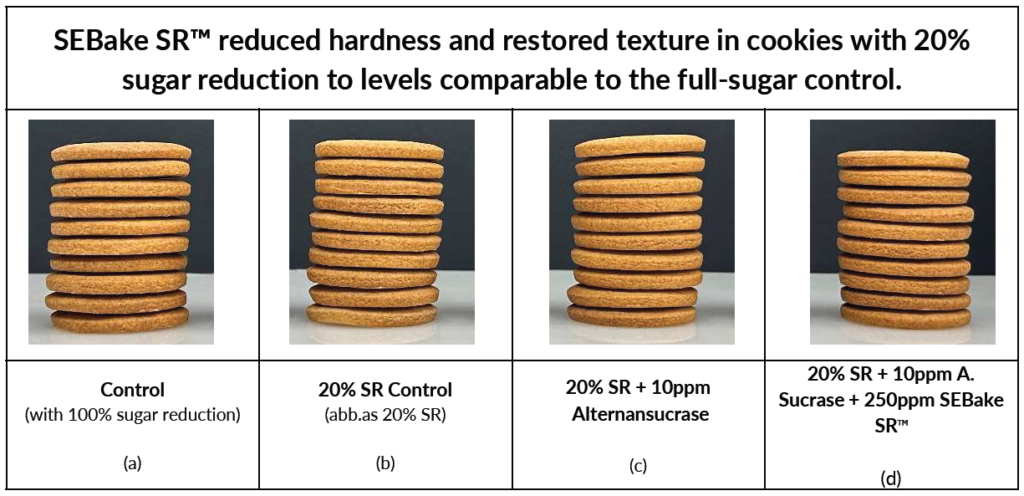 Figure 1. Cookie samples: (a) Control (100% sugar), (b) 20% sugar reduction (SR) control, (c) 20% SR + 10 ppm alternansucrase, (d) 20% SR + 10 ppm alternansucrase + 250 ppm SEBake SR™
One of the most common consequences of sugar reduction is increased cookie hardness. Fracture force measurement results showed:
- 14.3 N | Full-sugar control
- 17.5 N | 20% sugar-reduced control
- 13.0 N | 20% reduction + 10 ppm alternansucrase + 250 ppm SEBake SR™
The cookies formulated with 250 ppm SEBake SR™ + 10 ppm alternansucrase were even softer than the full-sugar control.
Color: Back to Golden
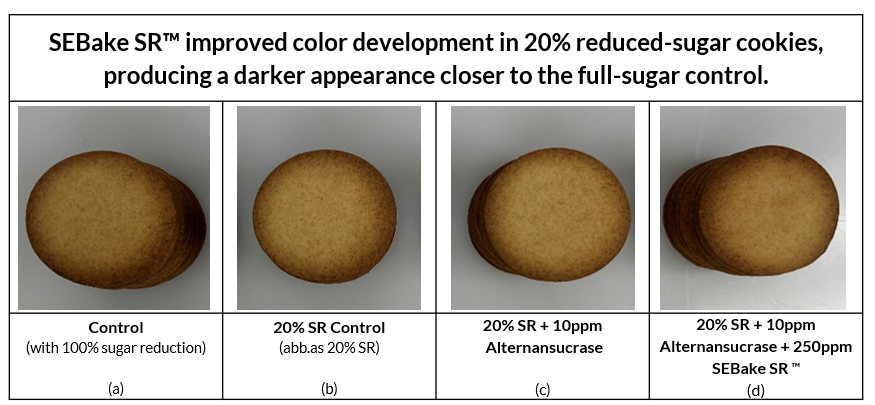
Figure 2. Cookie samples showing color differences: (a) Control (100% sugar), (b) 20% sugar reduction (SR) control, (c) 20% SR + 10 ppm alternansucrase, (d) 20% SR + 10 ppm alternansucrase + 250 ppm SEBake SR™
Reduced-sugar cookies often exhibit less browning during baking because less sugar is available to participate in browning reactions.
With L* = measurement of lightness, the study showed:
- L* = 65.3 | Full-sugar control
- L* = 66.4 | 20% sugar-reduced control
- L* = 64.6 | 20% reduction + 10 ppm alternansucrase + 250 ppm SEBake SR™
Cookies formulated with SEBake SR™ + alternansucrase demonstrated improved color development and a closer visual resemblance to the full-sugar control.
Sensory: Consumers Couldn’t Tell
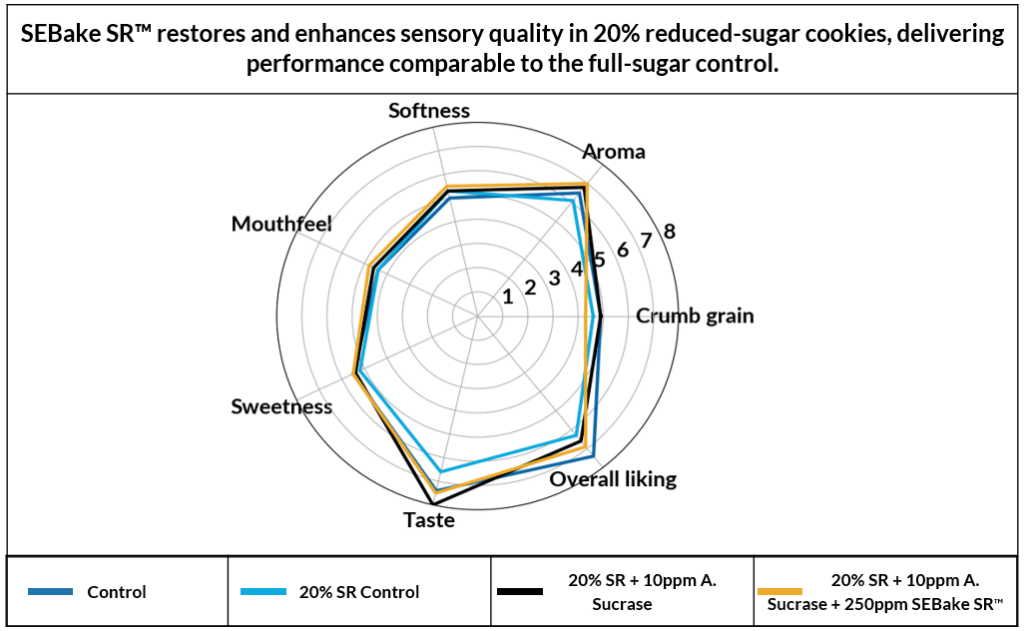
Figure 3. Sensory profile of cookies with 20% sugar reduction: (a) Control (100% sugar), (b) 20% sugar reduction (SR) control, (c) 20% SR + 10 ppm alternansucrase, (d) 20% SR + 10 ppm alternansucrase + 250 ppm SEBake SR™
Consumer acceptance is the ultimate test, and the sensory scores tell the story: • 41.0 | Full-sugar control
- 38.5 | 20% sugar-reduced control
- 41.4 | 20% reduction + 10 ppm alternansucrase + 250 ppm SEBake SR™
Taste alone climbed from 6.6 in the reduced-sugar control to 7.5 in the enzyme treated cookie. Results show overall quality was maintained despite the sugar cut.
What This Means for Bakers
Successful sugar reduction takes more than swapping out a sweetener. It hinges on protecting the functions sugar performs, from mixing bowl to shelf⁵˒⁸. By modifying sucrose rather than replacing it, enzyme technology offers a practical path to lower-sugar bakery products with fewer quality compromises¹˒³˒⁶.
Key Takeaways
- 20% reduction in sugar is achievable without sacrificing product quality • Texture can be preserved, comparable to full-sugar formulations • Color development improves, keeping reduced-sugar cookies visually appealing
- Sensory scores, including taste and overall acceptability, match traditional cookie formulations
- Enzyme technology preserves sugar functionality rather than simply replacing sweetness
Lower Sugar Without the Compromise
As consumer demand for reduced-sugar products continues to rise, bakers face mounting pressure to balance nutritional goals with product quality.
While traditional sugar replacement strategies often involve compromises, enzyme technology offers an alternative by helping to preserve the functional benefits of sugar during processing.
In this study, cookies formulated with SEBake SR™ + alternansucrase maintained texture, color and sensory performance comparable to full-sugar formulations despite a 20% reduction in sugar.
For bakers under pressure to reformulate, enzyme-based solutions make lower sugar a win instead of a compromise.
References
- Chen, Y., et al. Structurally Modified Polysaccharides: Physicochemical Properties, Biological Activities, Structure–Activity Relationship, and Applications. Journal of Agricultural and Food Chemistry, 2024.
- Erickson, S., and Carr, J. The Technological Challenges of Reducing the Sugar Content of Foods. Nutrition Bulletin, 2020.
- Gomes, A., et al. Strategies for the Reduction of Sugar in Food Products. Food Structure Engineering and Design for Improved Nutrition, Health and Well-Being, 2023.
- Gomez-Betancur, A. M., et al. Effect of Rare Sugars on Physical and Sensory Properties of Doughs and Biscuits. Food Hydrocolloids for Health, 2025. 5. Luo, X., et al. A Review of Food Reformulation of Baked Products to Reduce
Added Sugar Intake. Trends in Food Science & Technology, 2019. 6. Method for Reducing the Quantity of Sugar Consumed in Baked Goods. Technical report, 2025.
- Rice, T., et al. A Review of Polyols: Biotechnological Production, Food Applications, Regulation, Labeling and Health Effects. Critical Reviews in Food Science and Nutrition, 2020.
- Struck, S., et al. Sugar Replacement in Sweetened Bakery Goods. International Journal of Food Science and Technology, 2014.
- Swithers, S. E., et al. High-Intensity Sweeteners and Energy Balance. Physiology & Behavior, 2010.
10. Zorn, H., et al. Safety Evaluation of the Food Enzyme Alternansucrase from Genetically Modified Escherichia coli. EFSA Journal, 2025.